
Axon AI-Assisted Police Report Case Study
Proposed Pilot For Faster Report Writing And More Officer Time In The Field
Status: Proposed CityBudget.Ai case study. This is not a claim that the Huntington Beach Police Department has purchased or activated Axon Draft One.
The Opportunity
Huntington Beach police officers must document traffic stops, arrests, investigations, witness statements, and other incidents in written reports. Body-worn cameras may capture much of the conversation, but officers still spend substantial time reconstructing events and preparing report narratives.
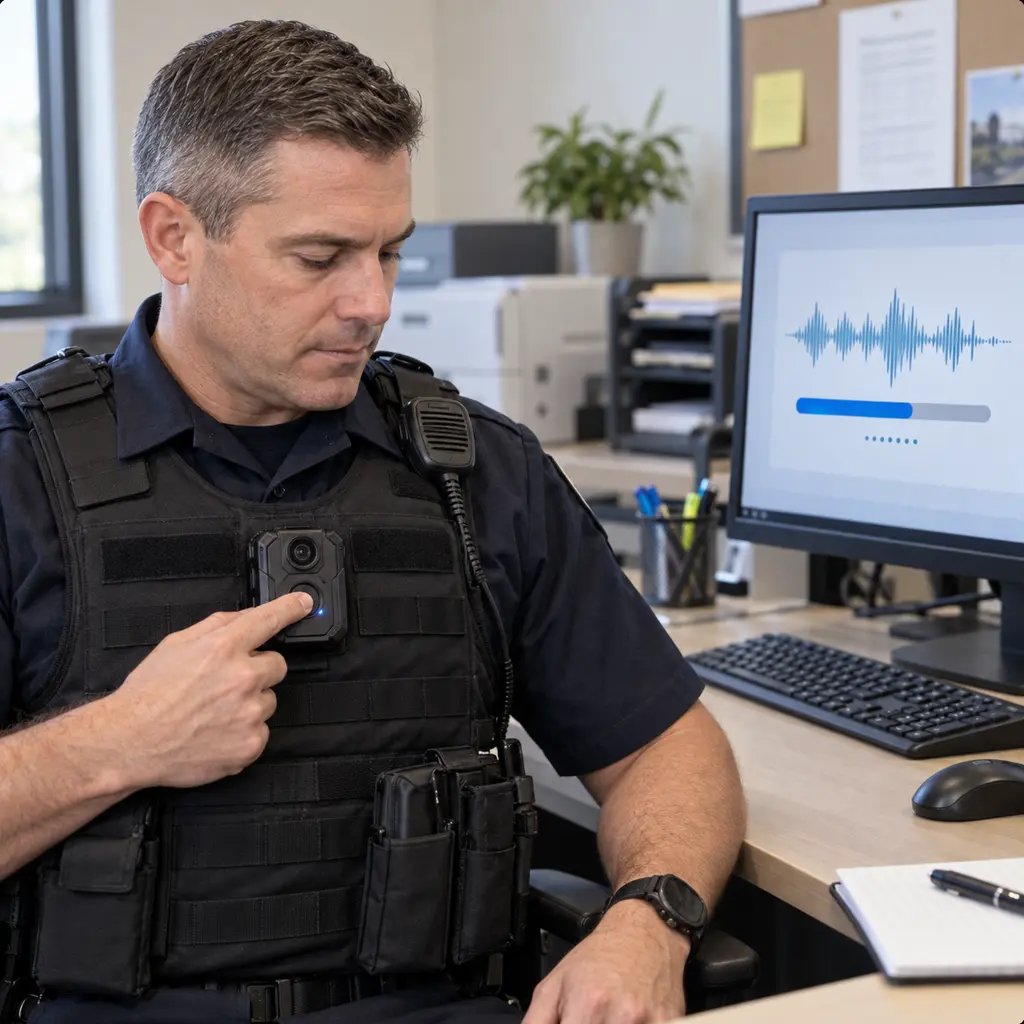
CityBudget.Ai proposes that HBPD evaluate Axon Draft One, an AI-assisted report-writing tool that uses body-camera audio to prepare an initial narrative. The officer remains responsible for reviewing, correcting, completing, and signing the official report.
The objective is not to replace officers or their judgment. It is to determine whether technology can reduce repetitive report-writing time while maintaining or improving accuracy, completeness, and legal reliability.
How California Cities Are Using This Technology
California departments began using or testing Axon Draft One before the state enacted specific disclosure and retention requirements. Their experience shows that the product can generate a useful first draft quickly, but it also confirms the need for officer review, restricted report categories, audit records, and independent performance measurement.
1 Fresno
Current Status: In July 2024, the Fresno City Council approved a five-year, $18.37 million technology agreement with Axon. The larger agreement covers 800 body-worn cameras and TASER devices, Evidence.com storage, computer-aided dispatch, records management, and related software. Published reporting identifies Draft One as one of the tools being used by Fresno officers.
Time-Saving View: Fresno officers have reported that Draft One can turn body-camera audio into a narrative draft within seconds and reduce the time required to begin a report. Axon has publicized a reported 20% to 25% reduction in report-writing time in Fresno, but CityBudget.Ai did not locate a publicly released independent Fresno evaluation validating that percentage. Huntington Beach should establish its own baseline and measure actual minutes saved.
Legal Legitimacy: The AI output is treated as a draft. The officer must compare it with the recording and other evidence, correct errors, add visual or off-camera facts, and accept responsibility for the final report. Fresno must now operate under California Penal Code section 13663, including AI disclosure, officer verification, first-draft retention, and audit-trail requirements.
How It Is Working Now: Available reporting indicates that Fresno continued incorporating Axon software into its broader evidence, records, and reporting environment. Officers have described faster drafting, but the City has not published a complete public scorecard showing average time saved, error rates, supervisor corrections, prosecutorial outcomes, and net financial savings. Fresno therefore supports the value of a pilot, not an assumption that savings are guaranteed.
2 East Palo Alto
Current Status: East Palo Alto was using Draft One by 2024. Contemporary reporting stated that the department was budgeted for 36 sworn officers and was eight officers short. Its reported Draft One cost was approximately $70 per body camera per month, or about $40,000 annually at that time.
Time-Saving View: An East Palo Alto officer reported that the program helped overcome writer's block after a long shift. The officer could select Draft One and receive a narrative based on the body-camera transcript within seconds. Officers also began describing visible evidence aloud during incidents so that important observations would appear in the transcript used to prepare the draft.
Legal Legitimacy: Speaking observations aloud can improve the source transcript, but it does not make the transcript or AI narrative a complete record. Officers must still add facts that were seen but not spoken, check names and quotations, and verify legal elements against the recording and other evidence.
How It Is Working Now: The department's early experience illustrates a practical benefit for a smaller, short-staffed agency: faster creation of an organized first draft. Publicly available information through September 2026 does not provide a complete current East Palo Alto performance report or a final net-savings calculation. A 2025 report also stated that the department had not yet issued an official response regarding implementation of the newly enacted SB 524 requirements.
3 Campbell
Current Status: Campbell was publicly identified in 2024 as one of the California police departments using Axon Draft One. Public-record requests concerning its use of the software have also been completed.
Time-Saving View: Reporting grouped Campbell with departments that praised the program's speed and ability to reduce the time needed to prepare an initial narrative.
Legal Legitimacy: The useful model is human-in-the-loop report writing. Draft One prepares preliminary text, while the officer remains responsible for reviewing the source evidence, correcting the narrative, adding missing facts, and signing the official report.
How It Is Working Now: CityBudget.Ai did not locate a current Campbell report publishing average minutes saved, factual-error rates, prosecutor feedback, or annual net savings. Campbell demonstrates that a California department has used the technology, but it does not provide enough public outcome data to justify projecting the same results for HBPD without a measured pilot.
4 San Mateo
Current Status: San Mateo was also publicly identified as using Draft One in 2024. It was among the early Northern California departments using body-camera audio to generate initial report narratives.
Time-Saving View: Published reporting stated that San Mateo and other early agencies praised the speed and time-saving potential of the tool. The system can organize spoken information into a chronological first draft, reducing the amount of time an officer spends starting from a blank report.
Legal Legitimacy: Audio can preserve details that were spoken during a rapidly developing incident, but Draft One does not analyze every relevant visual fact or guarantee that a transcript is correct. The officer must compare the narrative with the source recording, physical evidence, witness information, and personal observations.
How It Is Working Now: CityBudget.Ai did not locate a public San Mateo evaluation through September 2026 showing independently measured time savings, material-error rates, court outcomes, or net budget savings. San Mateo's experience is evidence of operational use, not proof of a particular financial return.
5 San Francisco
Current Status: San Francisco conducted a more clearly defined pilot beginning in May 2025. The test included 54 officers at the Central and Southern stations. Draft One was limited to citations and misdemeanor cases and excluded domestic violence, sexual assault, driving under the influence, and arrest-related narratives.
Time-Saving View: The stated purpose was to make officers more efficient and return them to field duties sooner. The limited scope resembles the approach recommended in this HBPD case study: begin with lower-risk reports and evaluate the results before expanding.
Legal Legitimacy: San Francisco required officers to enter missing details, proofread the AI-generated narrative, sign for accuracy, and disclose when Draft One was used. Department leaders and the District Attorney's Office were expected to evaluate the pilot before any broader use.
How It Is Working Now: The pilot was scheduled to run through August 2025. CityBudget.Ai did not locate a final public San Francisco evaluation or a confirmed departmentwide expansion through September 2026. San Francisco is therefore best described as a documented limited pilot, not a completed proof of citywide savings.
What The California Experience Shows
The five cities provide useful but incomplete evidence:
- Draft One can generate an organized narrative within seconds after usable audio is available.
- Officers report that it can reduce writer's block and time spent beginning routine reports.
- The quality of the draft depends on audio quality and whether important facts were spoken.
- Officers must add visual observations, off-camera facts, legal elements, and other evidence.
- Publicly available city-by-city measurements of error rates, supervisor time, court outcomes, and net savings remain limited.
- California law now requires stronger disclosure, retention, audit, and officer-verification protections than existed during many early deployments.
These experiences support a carefully measured HBPD pilot. They do not support purchasing the software based solely on vendor claims or anecdotal reports.
Chula Vista Verification Note
The earlier research supplied for this case study stated that Chula Vista used Draft One and saved approximately 45 minutes per report. CityBudget.Ai could not verify that claim in reliable public sources. Chula Vista is well documented as a leader in drones and other AI-assisted public-safety technology, but it should not be identified as a Draft One agency unless the City or Axon supplies confirming documentation.
How The Proposed HBPD System Would Work
Incident is recorded
The officer's body-worn camera records the encounter under existing HBPD activation policies.
Evidence is uploaded
Audio and video are transferred to the department's evidence-management system through its existing approved process.
AI prepares a draft
Draft One transcribes the audio and generates a preliminary chronological narrative. Axon states that a draft can become available within minutes after the audio upload is completed.
Officer verifies every fact
The officer compares the draft with the recording, CAD information, citations, witness statements, physical evidence, and personal observations. The officer adds facts that were visual, off camera, or not spoken aloud.
Officer signs the official report
The officer confirms that the completed report has been reviewed and is true and correct.
Supervisor performs normal review
AI-assisted reports go through the same supervisory approval process as reports written without AI.
Draft One would never be permitted to approve, sign, or submit a report independently.
Recommended Six Month Pilot
The pilot would include approximately 20 to 30 trained patrol and traffic officers, supported by designated supervisors.
| Phase | Duration | Purpose |
|---|---|---|
| Due diligence | 30 to 45 days | Confirm HBPD's Axon products, RMS compatibility, pricing, security, and legal requirements |
| Baseline measurement | 30 days | Measure existing report-writing time, supervisor review time, and correction rates |
| Training and testing | 2 weeks | Test access, disclosures, retention, audit records, and excluded report categories |
| Live pilot | 120 days | Use Draft One for approved lower-risk reports |
| Final evaluation | 30 days | Compare time, quality, compliance, and total cost with the baseline |
Reports Included In The Initial Pilot
The first phase should be limited to routine reports with adequate body-camera audio, such as:
- Informational reports
- Selected property crimes
- Lost-property and vandalism reports
- Selected noncustodial misdemeanors
- Selected public-disorder incidents
- Traffic incidents without serious injuries
Reports Initially Excluded
To control legal and public-safety risk, the pilot should initially exclude:
- Felony and arrest reports
- Domestic-violence cases
- Sexual offenses
- Crimes against children
- Juvenile investigations
- Serious-injury or fatal collisions
- Uses of force
- Officer-involved shootings
- Death investigations
- Confidential informants and covert operations
HBPD could add another report category only after the initial results satisfy the pilot's accuracy and compliance standards.
California Legal Safeguards
California Senate Bill 524 added Penal Code section 13663, establishing requirements for AI-assisted law-enforcement reports. The HBPD pilot would require:
- Identification of the specific AI program used
- A prominent disclosure that AI helped write the report
- The officer's physical or electronic signature
- Officer verification that the report was reviewed and is factually correct
- Retention of the first AI-generated draft for as long as the official report
- An audit trail identifying the user and source audio or video
- Contractual restrictions on the vendor's use or sharing of police data
Axon's documentation indicates that original-draft retention is configurable and may be turned off by default. HBPD would therefore need to enable and test retention before officers use the system on actual cases.
Illustrative Efficiency Potential
The following example demonstrates how the pilot could calculate operational value. It is not a forecast or guaranteed savings estimate.
| Assumption | Illustrative amount |
|---|---|
| Participating officers | 30 |
| Eligible reports per officer each week | 4 |
| Average time saved per report | 20 minutes |
| Productive weeks per year | 48 |
| Potential annual officer hours redirected | 1,920 hours |
At an illustrative loaded labor value of $85 to $110 per hour, 1,920 redirected hours would represent approximately $163,000 to $211,000 of annual operational capacity among the participating officers.
This should not automatically be described as a cash budget reduction. It becomes a financial benefit only if HBPD can document lower overtime, a reduced report backlog, faster response to calls, more proactive patrol time, absorption of increased workload, or avoided future staffing costs.
Software, integration, training, storage, administration, legal review, and quality-control costs must be deducted before calculating net value.
Required Performance Standards
| Measurement | Proposed standard |
|---|---|
| Officer report-writing time | At least 25% lower than the matched baseline |
| Supervisor review time | No increase greater than 5% |
| Report accuracy | No worse than officer-written baseline |
| Report completeness | No worse than baseline |
| Material errors | Zero unresolved material errors |
| Legal disclosures and signatures | 100% compliance |
| First-draft retention and audit records | 100% compliance |
| Financial result | Positive net value or a documented operational benefit |
At least 10% of AI-assisted reports, with a minimum sample of 50, should be compared against the underlying evidence by a qualified reviewer.
Stop Conditions
HBPD should immediately suspend the pilot for failure to retain a required AI draft, missing AI disclosures, unauthorized access or data use, repeated material inaccuracies, inability to produce audit records, a discovery or prosecutorial problem, or a legal determination that the workflow is noncompliant.
Recommended City Action
Huntington Beach should authorize due diligence and a limited pilot, not a departmentwide purchase.
Before approval, HBPD should:
- Confirm its current Axon camera, evidence-management, and software licenses.
- Determine whether Draft One integrates with HBPD's records-management system.
- Obtain separate pricing for Draft One and any proposed Axon One bundle.
- Complete City Attorney, cybersecurity, procurement, labor, and retention reviews.
- Consult with the Orange County District Attorney regarding discovery and prosecution procedures.
- Establish a not-to-exceed pilot cost.
- Return with a public results report before considering broader deployment.
CityBudget Ai Conclusion
Axon Draft One could help HBPD convert body-camera audio into a useful first draft and return meaningful officer time to public-safety work. However, Huntington Beach should demonstrate that benefit with local evidence rather than relying on vendor estimates.
A controlled pilot gives HBPD the opportunity to test the technology while protecting officer accountability, report accuracy, evidence integrity, public transparency, and California legal compliance.
Sources
- City of Fresno Axon contract and staff report
- KQED report on Fresno, East Palo Alto, Campbell, and San Mateo
- KQED report on California's new AI police-report safeguards
- San Francisco Draft One pilot reporting
- Axon Draft One product guide
- Axon administration safeguards
- Axon auditing and draft retention
- California SB 524 chaptered text